
 Contact Us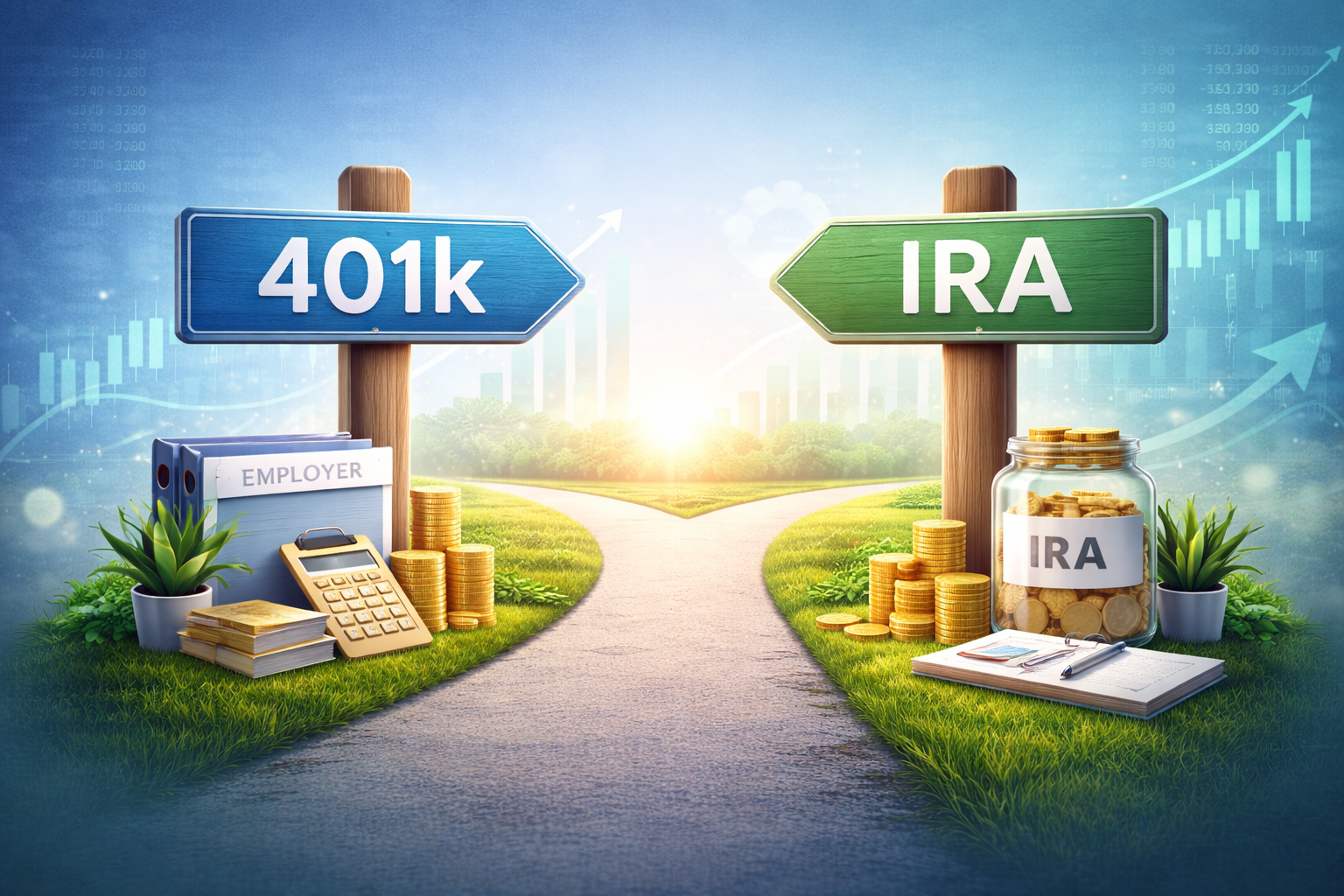
Planning for retirement is one of the most important financial decisions you’ll make and it’s not just good for you but also for your partner and family. If you work in the US, you’ve probably heard about 401(k) and IRA accounts. While both are designed to help you save for retirement, yet they work in different ways and offer different benefits, so it is important for you to be aware of both.
Understanding the difference between a 401(k) and an IRA can help you choose the right option when you are planning for your retirement and you can even consider both to build a secure retirement fund.
What is a 401(k)?
A 401(k) is an employer-supported retirement plan. Yes, you thought it right. One of the biggest advantages of a 401(k) is employer matching. Many companies match part of your contribution, which is essentially free money added to your retirement savings.
It allows employees to contribute a portion of their salary directly into a retirement account before taxes (or after taxes in some cases).
Key Features of a 401(k)
- Offered through your employer
- Contributions are deducted automatically from your salary
- Higher annual contribution limits
- Often includes employer match
- Investment options are limited to what the employer offers
What is an IRA?
An Individual Retirement Account (IRA) is a retirement account you open and manage on your own. It is not tied to your employer and no contribution as well but it gives you more control over where and how you invest.
IRAs are typically opened through banks or online brokerages and provide access to a wide range of investment options. These include individual stocks, bonds, ETFs, index funds, and mutual funds. It is popular among freelancers, self-employed individuals, or those who want additional retirement savings beyond their workplace plan.
Key Features of an IRA
- Opened individually through banks or brokerages
- Lower contribution limits than a 401(k)
- More investment choices
- No employer involvement
- Ideal for long-term, flexible investing
Types of IRAs You Should Know About
- Traditional IRA: Tax-deductible contributions, taxed on withdrawal
- Roth IRA: After-tax contributions, tax-free withdrawals
- SEP IRA: For self-employed individuals with higher limits
- SIMPLE IRA: Offered by small employers with optional matching
401(k) vs IRA: Key Differences
1. Contribution Limits
A 401(k) allows you to contribute significantly more each year compared to an IRA. This makes it a better option if you want to save aggressively for retirement.
IRAs have lower limits, but they still play a valuable role in long-term planning.
2. Employer Match
This is where a 401(k) truly shines.
Many employers offer matching contributions up to a certain percentage of your salary. IRAs do not offer any employer match, as they are individually managed.
3. Investment Options
401(k) plans usually offer a limited set of investment options chosen by the employer.
IRAs give you much more freedom, allowing you to invest in stocks, bonds, ETFs, mutual funds, and more.
4. Tax Benefits
Both accounts offer tax advantages, but they differ slightly.
- Traditional 401(k) and Traditional IRA: Contributions may reduce your taxable income now, but withdrawals are taxed during retirement.
- Roth 401(k) and Roth IRA: Contributions are made after tax, but withdrawals in retirement are usually tax-free.
5. Access and Control
With a 401(k), your employer controls the plan structure and investment options.
With an IRA, you have full control over your account, provider, and investment choices.
6. Portability
If you change jobs:
- A 401(k) may need to be rolled over to a new plan or IRA
- An IRA stays with you no matter where you work
7. Early Withdrawals & Penalties
Both 401(k)s and IRAs are meant for long-term retirement savings. Withdrawals made before age 59½ may result in taxes and penalties unless they qualify for specific exceptions such as hardship withdrawals, first-time home purchases (IRA only), or qualified education expenses (IRA only).
8. Required Minimum Distributions
Traditional 401(k)s and Traditional IRAs require you to start taking minimum withdrawals after reaching a certain age, even if you don’t need the money. Roth IRAs do not require RMDs during the account holder’s lifetime, making them useful for estate planning and long-term tax efficiency.
Which One is Better: 401(k) or IRA?
There is no one-size-fits-all answer.
- If your employer offers a 401(k) match, it’s usually wise to contribute enough to get the full match.
- If you want more investment flexibility, an IRA is a great choice.
- Many investors use both to maximize retirement savings and tax benefits.
Can You Have Both a 401(k) and an IRA?
Yes, you can absolutely invest in both accounts at the same time, as long as you meet eligibility requirements.
This strategy allows you to:
- Take advantage of employer matching
- Increase total retirement savings
- Diversify tax benefits
Final Thoughts
Both 401(k) and IRA accounts are powerful tools for building long-term retirement wealth. The right choice depends on your income, employment status, investment goals, and tax strategy.
If possible, using both accounts together can offer the best balance of growth, flexibility, and tax efficiency.
FAQs
1. Is a 401(k) better than an IRA?
Not always. A 401(k) is great for employer matching, while an IRA offers more investment choices.
2. Can I contribute to an IRA if I already have a 401(k)?
Yes, as long as you meet income and eligibility rules.
3. What happens to my 401(k) if I leave my job?
You can roll it over into an IRA or your new employer’s plan.
4. Are IRAs safer than 401(k)s?
Both carry investment risk. Safety depends on how you invest, not the account type.
5. Can freelancers use a 401(k)?
Freelancers usually use IRAs or Solo 401(k)s.
6. Which account has lower fees?
IRAs often have lower fees, but this depends on the provider.
7. Can I withdraw money early from a 401(k) or IRA?
Early withdrawals may result in taxes and penalties.
8. Is Roth better than Traditional?
Roth is better if you expect higher taxes in retirement. Traditional helps reduce taxes now.
9. Do IRAs have employer contributions?
No, only 401(k)s may include employer matching.
10. Should beginners start with an IRA or 401(k)?
Beginners should start with a 401(k) if employer match is available, then consider an IRA.
Disclaimer
This content is for informational purposes only. Details may change and can vary by location. Please verify information from official sources before making any decisions. The author is not responsible for actions taken based on this content.